 THALWEG
Research
Two spawning seasons on the lower Grand River.
Thalweg was built on recordings from the spring run, during the lake sturgeon spawning migration. The river then is cold and fast and carrying a heavy sediment load, and it's uncooperative to work in. The software was shaped around that.
The study system
Lake sturgeon are long-lived and slow to mature, from a lineage that has been swimming since the age of the dinosaurs. They are listed as threatened in the State of Michigan. Every spring, adults move out of Lake Michigan and up the Grand River toward spawning reaches near downtown Grand Rapids.
The migration begins when the river warms to roughly seven degrees Celsius, and most of the movement happens at night, in water carrying enough sediment that visual methods aren't an option. Thalweg was built for a fixed acoustic station on that route, which can watch all of it.
One crossing in full
What the instrument measures
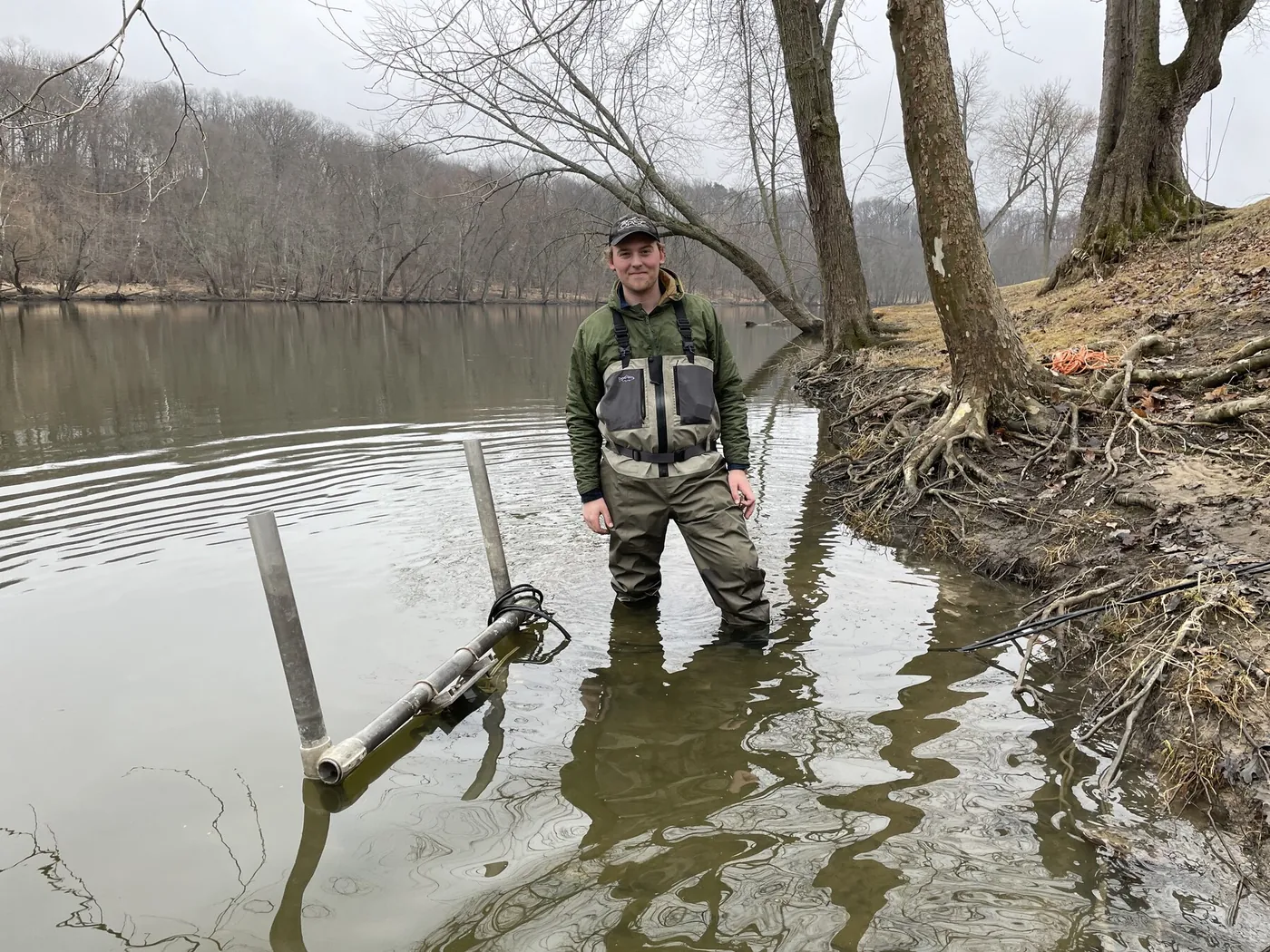
A fixed split-beam array is mounted on the bank and aimed across the channel. Because the beam is split, every echo carries direction as well as distance, so a target that crosses can be reconstructed as a path in three dimensions.
Thalweg turns those recordings into tracks and sorts fish out of the much larger population of everything else a river returns. What is left gets ranked, so a biologist starts at the top. The unit it reports is the beam crossing, which is what fisheries acoustics actually measures. Every crossing has a distance, a direction of travel and a length of time in the beam.
Field record
- 2025 season
- Over 600 hours of sonar recorded at a fixed station on the lower Grand River, spanning the spring run from first movement to the end of the migration.
- 2026 season
- A second spawning season at the same site. The field hardware was rebuilt for it, with remote access, automatic restart and off-site replication, so the station can be managed from anywhere. Recorded and archived. Analysis is under way.
- Publication
- The method and the 2025 season are documented in a Grand Valley State University M.S. thesis (Biology, 2026).
- Intellectual property
- Patent pending. A U.S. provisional application was filed in May 2026, and all intellectual property is owned solely by its inventor.
What comes next
Two seasons on the Grand River established the instrument. What it needs now is a second river, one Thalweg has never recorded, run alongside a fisheries or environmental monitoring program that already knows what its water contains.
If you run that kind of program, we'd like to talk. Comparing what Thalweg reports against a count you already trust is the quickest way to find out where it holds up and where it doesn't.